

The Solution: An Automated Content Pipeline
This automated content machine has revolutionized the client’s social media strategy
- Increased Efficiency: The time required to produce a YouTube Short has been reduced from hours to minutes.
- Consistent Output: The system can produce a new, trend-based video every day, ensuring a consistent stream of content for the client’s social media channels.
- Data-Driven Content: By leveraging data from Apify, the content is always relevant and has a higher chance of going viral.
- Scalability: The system is easily scalable, allowing for the production of multiple videos per day or expansion to other social media platforms.
For another practical automation example, read my case study on building an AI trading bot without coding.
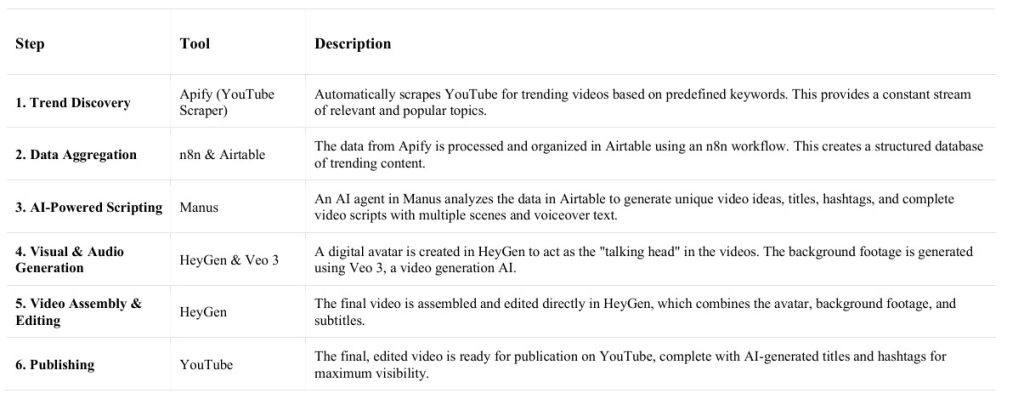
I’ve created the complete AI-driven content creation workflow, from discovering YouTube trends to publishing the final video.
It visualizes six key automation stages:
1️⃣ Trend Discovery with Apify YouTube Scraper,
2️⃣ Data Aggregation via n8n and Airtable,
3️⃣ AI-Powered Scripting using Manus,
4️⃣ Visual & Audio Generation with HeyGen and Veo 3,
5️⃣ Video Assembly & Editing in HeyGen, and
6️⃣ Publishing on YouTube.
The process demonstrates how creators can stay on top of YouTube trends and scale their production effortlessly with AI tools. By using AI content automation for YouTube Shorts, the team achieved consistent output and faster turnaround times.
The Outcome
This case study demonstrates the power of automation and AI in modern content creation. By building a “content machine,” businesses can overcome the challenges of social media marketing and create a sustainable, scalable, and effective content strategy. This project not only solved a critical business problem but also showcased the potential of integrating various AI tools to create a powerful, automated workflow. The project shows that AI content automation for YouTube Shorts can completely redefine how creators scale their online presence.