

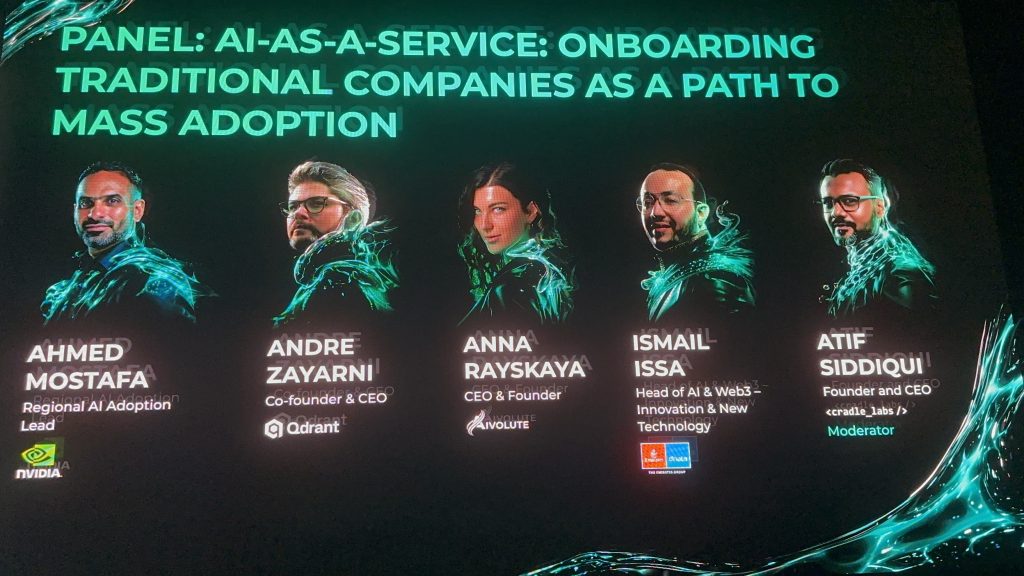
The artificial intelligence revolution isn’t unfolding in Silicon Valley boardrooms — it’s happening in small businesses, startups, and even in our living rooms. At the Function 1 AI Conference in Dubai, I had the opportunity to share insights on practical AI implementation strategies that deliver measurable ROI for small and medium businesses.
As an independent AI consultant specializing in SMB automation, I’ve witnessed firsthand how companies approach AI transformation—and more importantly, why most implementations fail. This article distills the key insights from my Function 1 talk, including real case studies, data-driven strategies, and a framework you can apply to your own business today.
The AI Revolution: Psychological, Not Technological
How Children Perceive AI: A Warning and an Opportunity
My six-year-old son recently told me our family consists of six members: his father, his two brothers, me, him—and Alisa, our smart speaker assistant (similar to Amazon Alexa). When I corrected him, explaining that Alisa is just a device, he insisted she was real because “she understands me, likes me, and appreciates me.”
This wasn’t just a cute childhood misconception. It was a profound insight into the AI revolution we’re experiencing.
Key insight: The ChatGPT explosion of 2023-2024 represents a psychological revolution, not merely a technological evolution. While the underlying technology may have evolved incrementally, the impact on human perception and behavior has been revolutionary.
Why This Matters for Business
When a six-year-old considers AI a family member, it signals a fundamental shift in how humans interact with artificial intelligence. This generation won’t distinguish between “human intelligence” and “artificial intelligence” the way previous generations do—they’ll simply interact with helpful agents that solve problems.
For businesses, this means AI implementation must focus on user experience and psychological adoption, not just technical capabilities.
The #1 Mistake Companies Make with AI Implementation
“We Need AI” Without Knowing Why
The most common scenario I encounter as an AI consultant:
Client: “We need AI for our business.”
Me: “What problem are you trying to solve?”
Client: “I’m not sure, but everyone says we need AI.”
This is the crisis of AI implementation in 2024. Companies are chasing trends rather than solving problems.
The data backs this up: According to recent McKinsey research on AI adoption, small and medium businesses are experiencing more measurable impact from AI than large corporations—contradicting traditional assumptions about enterprise technology adoption.
Why SMBs Are Winning the AI Race
Small businesses outperform corporations in AI adoption for several reasons:
- Clear problem identification: SMBs focus on specific pain points rather than abstract “digital transformation”
- Faster implementation cycles: No lengthy approval processes or committee reviews
- Immediate ROI measurement: Owners can directly measure time savings and efficiency gains
- Employee buy-in: Smaller teams see the direct impact on their daily work
This bottom-up revolution mirrors how consumer AI tools like ChatGPT gained adoption—through individual users experiencing immediate value, not through top-down mandates.
The Practical AI Implementation Framework
Based on my consulting experience with dozens of SMBs, here’s the framework that consistently delivers results:
Step 1: Identify the Most Annoying Task
Don’t start by asking “Where can we use AI?” Instead, ask your employees: “What task do you hate doing most?”
The answer is often surprisingly simple:
- Filling out repetitive forms
- Copying data between systems
- Writing similar documents repeatedly
- Responding to common customer questions
- Processing routine paperwork
Real example: One of my clients discovered that employees were frustrated by typing two extra letters in a form field. Once we automated that seemingly trivial task, employee satisfaction with the system increased dramatically.
Pro tip: The most annoying task is often not the most “strategic” one—and that’s okay. Start with quick wins that demonstrate value.
Step 2: Automate with AI (Start Small)
Once you’ve identified the pain point, design an AI solution that addresses only that specific problem. Resist the temptation to build a comprehensive system that solves everything.
Key principles:
- Focus on one workflow at a time
- Use existing AI tools when possible (don’t build from scratch)
- Ensure the solution is faster than the manual process
- Build in human review where necessary
This approach minimizes risk, reduces implementation time, and allows for rapid iteration based on user feedback.
Step 3: Turn Employees into Advocates
When employees experience immediate relief from tedious tasks, they become your biggest AI champions. This organic advocacy is far more effective than top-down mandates.
Why this matters:
- Employees voluntarily adopt the tool
- They suggest additional use cases
- They defend the system when others are skeptical
- They become internal trainers for new hires
The goal isn’t just to implement AI—it’s to create a culture where employees want to use AI tools because they experience tangible benefits.
Real Case Study: AI for Government Tender Automation
The Problem
A client in the government procurement sector was spending approximately four hours preparing each commercial proposal in response to tenders. The process involved:
- Reading lengthy technical specifications
- Understanding complex requirements
- Translating technical language into commercial terms
- Formatting proposals according to tender guidelines
With multiple tenders per week, this represented a significant time drain and bottleneck in their business development process.
The AI Solution
We implemented an AI system that:
- Reads and parses technical specifications from tender documents
- Extracts key requirements and constraints
- Matches requirements to the company’s capabilities
- Generates a first-draft commercial proposal
- Formats the output according to standard templates
The Results
Time savings:
- Before: 4 hours per proposal
- After: 30 minutes (including human review and customization)
- Total time saved: 3.5 hours per tender (87.5% reduction)
Business impact:
- The founder could bid on more tenders per week
- Faster response time improved competitive positioning
- Quality remained high due to human oversight
- The founder became the system’s biggest advocate
ROI: The client saw immediate return on investment. Within the first month, the time savings allowed the team to pursue additional opportunities that more than covered the implementation cost.
Key success factor: We didn’t aim for 100% automation. The AI handles the tedious reading and drafting, while humans provide strategic thinking and final quality control. This hybrid approach maximizes efficiency while maintaining quality.

Why Traditional AI Implementation Approaches Fail
Starting Too Big
Many companies try to implement comprehensive AI systems that transform entire departments or workflows. This approach typically fails because:
- Long implementation timelines reduce urgency
- Multiple stakeholders create competing requirements
- High complexity increases failure risk
- Delayed ROI undermines support
Better approach: Start with a single, well-defined task that can be automated in weeks, not months.
Ignoring the Human Element
AI implementation is fundamentally a change management challenge, not a technical one. The technology often works fine—it’s the human adoption that fails.
Common mistakes:
- Not involving end-users in the design process
- Implementing AI that makes employees’ jobs harder, not easier
- Failing to provide adequate training
- Not addressing job security concerns
Solution: Treat AI as a tool that augments human capabilities, not replaces them. Involve employees early, communicate transparently, and demonstrate how AI makes their work more meaningful.
Measuring the Wrong Metrics
Companies often measure AI success by:
- Amount of data processed
- Number of AI models deployed
- Sophistication of algorithms used
Better metrics:
- Time saved per employee
- Tasks completed per day
- Employee satisfaction scores
- Revenue per employee
- Customer satisfaction improvements
Focus on business outcomes, not technical achievements.
AI Implementation Trends: What the Data Shows
McKinsey Research on AI Adoption
Recent McKinsey research reveals surprising trends in AI adoption across different business sizes:
Key findings:
- SMBs report higher AI impact: Small and medium businesses are experiencing more measurable improvements from AI than large enterprises
- Individual adoption drives organizational change: Freelancers and individual contributors are often the first to adopt AI tools, which then spread organizationally
- Bottom-up vs. top-down: Generative AI adoption is following the opposite pattern of previous enterprise technologies
Why this matters: If you’re an SMB owner, you have a competitive advantage in AI adoption. Your size is a strength, not a weakness.
The Generative AI Difference
Traditional AI/ML tools required:
- Data science expertise
- Large datasets
- Custom model training
- Significant capital investment
Generative AI (ChatGPT, Claude, GPT-4, etc.) changed the game:
- Accessible through simple interfaces
- Pre-trained on vast datasets
- Works out-of-the-box for many tasks
- Affordable for individuals and small businesses
This democratization explains why SMBs are winning the AI race—the barriers to entry have collapsed.
Practical AI Use Cases for Small Businesses
Content Creation and Marketing
Applications:
- Blog post drafts and outlines
- Social media content generation
- Email marketing campaigns
- Product descriptions
- SEO-optimized content
Tools: ChatGPT, Claude, Jasper, Copy.ai
Best practices:
- Use AI for first drafts, not final copy
- Maintain brand voice through custom prompts
- Always fact-check AI-generated content
- Use AI to overcome writer’s block, not replace writers
Customer Service Automation
Applications:
- Chatbots for common questions
- Email response drafting
- Knowledge base creation
- Customer inquiry categorization
Tools: Intercom, Zendesk AI, Custom GPT implementations
Best practices:
- Start with FAQ automation
- Provide escalation paths to humans
- Monitor conversation quality regularly
- Use customer feedback to improve responses
Business Process Automation
Applications:
- Data entry and form filling
- Document processing and summarization
- Report generation
- Invoice processing
- Meeting notes and action items
Tools: Zapier with AI, Make.com, Custom solutions with OpenAI API
Best practices:
- Map existing workflows before automating
- Test with small batches first
- Maintain audit trails
- Keep humans in the loop for critical decisions
Sales and Business Development
Applications:
- Proposal writing (like my tender case study)
- Lead qualification
- Personalized outreach at scale
- CRM data enrichment
- Sales call summarization
Tools: GPT-4 API integrations, HubSpot AI, Salesforce Einstein
Best practices:
- Personalize AI outputs for each prospect
- Use AI to save time, not to spam
- Verify AI-generated claims before sending
- Track which AI-assisted approaches convert best
How to Get Started with AI in Your Business
Week 1: Assessment
- Survey your team: What tasks do they find most tedious?
- Document workflows: Map out how work currently gets done
- Identify bottlenecks: Where do delays or errors commonly occur?
- Prioritize opportunities: Which pain points are both annoying AND frequent?
Week 2-3: Pilot Implementation
- Choose one specific task from your assessment
- Research existing tools that might solve it (don’t build custom if you don’t have to)
- Test with a small group (2-5 users maximum)
- Gather feedback daily during the pilot
- Iterate quickly based on what you learn
Week 4: Measure and Expand
- Calculate time saved per person per week
- Document quality improvements or error reductions
- Collect user testimonials from pilot participants
- Roll out to broader team if successful
- Identify next use case using lessons learned
Budget expectations:
- Small pilots: $100-500/month (using existing SaaS tools)
- Custom implementations: $2,000-10,000 one-time (for specialized needs)
- Ongoing costs: $50-300/month per user (depending on tools)
Timeline expectations:
- Simple automation: 1-2 weeks from idea to production
- Moderate complexity: 4-6 weeks including testing
- Complex systems: 2-3 months with proper planning
Common Objections to AI Implementation (And How to Address Them)
“We Don’t Have the Technical Expertise”
Reality: Most effective AI implementations use no-code or low-code tools that don’t require data science expertise.
Solution: Start with user-friendly tools like ChatGPT Plus, Zapier with AI, or industry-specific AI solutions. Hire a consultant for the initial setup if needed.
“AI Will Replace Our Employees”
Reality: AI is best at augmenting human capabilities, not replacing them. Your employees will do more valuable work, not less work.
Solution: Frame AI as a tool that eliminates tedious tasks so employees can focus on creative, strategic, and relationship-based work.
“We Don’t Have Enough Data”
Reality: Generative AI doesn’t require training on your data—it comes pre-trained.
Solution: Use foundation models (GPT-4, Claude) that already have broad knowledge. You only need data for fine-tuning, which most SMBs don’t need.
“It’s Too Expensive”
Reality: The cost of NOT implementing AI is increasingly higher than implementation costs.
Solution: Calculate the cost of manual labor for repetitive tasks. If someone spends 5 hours/week on a task that AI could reduce to 1 hour, that’s 4 hours × 50 weeks = 200 hours/year saved.
“Our Industry Is Too Specialized”
Reality: AI can be prompted to understand specialized domains—I’ve successfully implemented AI in government procurement, legal, healthcare, and manufacturing contexts.
Solution: Provide AI tools with context about your industry through system prompts, examples, and document templates specific to your field.
The Future of AI in Small Business
Trend 1: AI Agents vs. AI Tools
The next wave of AI won’t just respond to prompts—it will take autonomous action. AI agents will:
- Monitor systems and trigger actions automatically
- Make decisions within defined parameters
- Coordinate across multiple tools and platforms
- Learn from outcomes and improve over time
For SMBs: This means even greater automation potential, but also the need for clear guardrails and oversight.
Trend 2: Multimodal AI
AI is moving beyond text to process:
- Images and visual content
- Audio and voice
- Video analysis
- Combined modalities simultaneously
For SMBs: Expect AI tools that can analyze customer service calls, extract insights from product photos, or generate video marketing content from text briefs.
Trend 3: Industry-Specific AI Solutions
Generic AI tools are being supplemented by specialized solutions for:
- Legal document analysis
- Medical diagnosis support
- Financial modeling
- Manufacturing quality control
- Retail inventory optimization
For SMBs: Look for AI tools built specifically for your industry—they’ll require less customization and deliver faster ROI.
Trend 4: AI Regulation and Compliance
Governments worldwide are implementing AI regulations around:
- Data privacy and protection
- Algorithmic transparency
- Bias and fairness
- Accountability for AI decisions
For SMBs: Stay informed about regulations in your jurisdiction. Build in human oversight for high-stakes decisions. Document your AI usage policies.
Key Takeaways from Function 1 Dubai Conference
AI implementation is a psychological challenge, not just technical: How users perceive and adopt AI matters more than the underlying technology.
Small businesses have a competitive advantage: Agility, clear problem focus, and direct ROI measurement help SMBs outpace enterprises in AI adoption.
Start with annoying tasks, not strategic initiatives: Quick wins build momentum and create internal advocates for broader AI adoption.
The framework that works:
- Identify the most annoying task
- Automate it with AI
- Turn employees into fans
- Repeat with the next task
Real ROI comes from time savings: My government tender case study demonstrated 87.5% time reduction—this is typical of well-implemented AI solutions.
Human-AI collaboration beats full automation: Keep humans in the loop for quality control, strategic thinking, and relationship management.
The revolution is already here: When six-year-olds consider AI family members, we’re not preparing for the future—we’re adapting to the present.
Resources and Next Steps
Want to Implement AI in Your Business?
As an independent AI consultant, I help small and medium businesses identify practical AI use cases and implement solutions that deliver measurable ROI.
Services I offer:
- AI readiness assessment for your business
- Use case identification and prioritization
- Implementation of custom AI solutions
- Training for your team on AI tools
- Ongoing optimization and support