
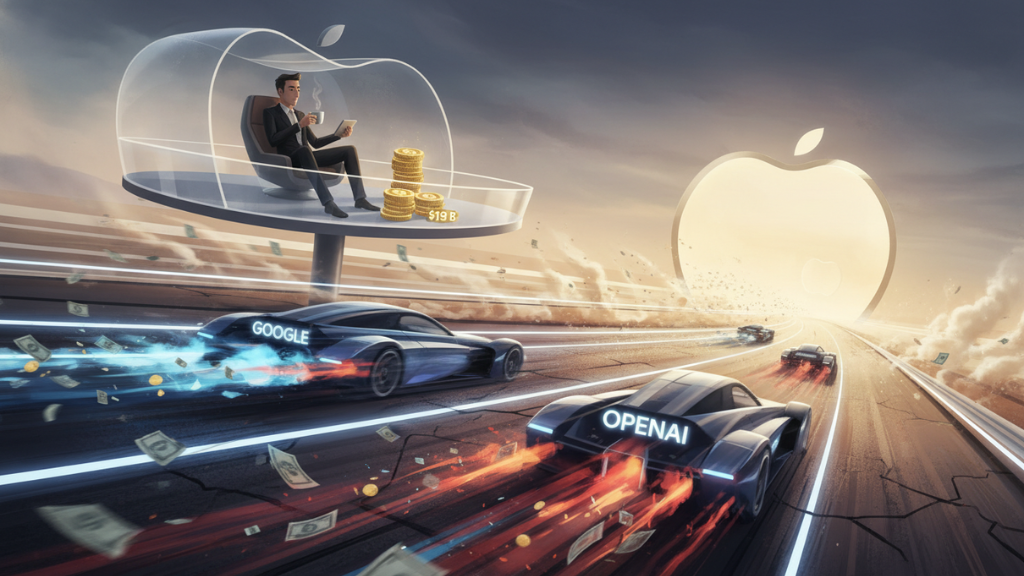
As someone who’s been tracking the AI industry closely, I’ve noticed a fascinating paradox in what many call the Apple AI strategy. In the recent Apple-Google AI partnership announcement, most commentators missed the real story.
Last week, headlines screamed about Apple’s “surrender” in the AI race — the company is reportedly paying Google $1 billion annually to integrate Gemini into Siri. Everyone framed it as a desperate move from a tech giant that lagged behind in the generative-AI revolution.
But here’s what the narrative conveniently overlooks: Google has been paying Apple around $20 billion per year just to stay the default search engine in Safari.
Let’s do the math. Apple pays $1 billion and earns $20 billion. That’s a net profit of $19 billion annually from their Google AI partnership alone — and that’s before we even factor in Apple’s hardware and services revenue.
This reveals something fascinating about the current AI business model. We’re witnessing an unprecedented arms race where prestige matters more than profit. Companies are spending billions to build bigger models, expand context windows, and chase user acquisition — often at the expense of their bottom line.
OpenAI is losing money. Google’s AI division is unprofitable. The entire industry is essentially powered by investor capital and prestige. In contrast, Apple’s AI strategy quietly focuses on profitability and brand control — a model that looks boring, but works.
Meanwhile, Apple chose a different path. Yes, they missed the first generative-AI wave. Yes, Google’s models are currently more advanced. But Apple is renting intelligence instead of burning cash — temporarily leveraging Gemini while training its own models in-house.
In an industry obsessed with speed, Apple’s AI business model prioritizes stability. It’s a strategy rooted in patience — or, as some might say, strategic laziness.
The irony is clear: being a successful AI company today doesn’t mean being profitable. It means burning through capital faster than competitors while hoping the funding continues. Apple, however, earns billions by simply sitting out the race.
Even Microsoft couldn’t break Apple’s Safari search deal despite offering 90 % of Bing’s revenue — proving how powerful this quiet strategy really is.
If you’re exploring AI consulting or building your own AI automation systems, check out my article on how companies profit from AI adoption.